EMT Practice Test

1. Question Content...


Question List

Question1: Which of the following is a test task that usually occurs during test implementation?

Question2: Which of the following s the most correct statement about state testing techniques?

Question3: Which of the following statements about branch coverage is true?

Question4: Which sequence of stated in the answer choices is correct in accordance with the following figure depicting the life-cycle of a defect?

Question5: Can "cost" be regarded as Exit criteria?

Question6: Test automation allows you to:

Question7: Which of the following issues cannot be identified by static analysis tools?

Question8: Which of the following statements is true?

Question9: Consider a given test plan which, among others, contains the following three sections: "Test Scope", "Testing Communication", and "Stakeholders". The features of the test object to be tested and those excluded from the testing represent information that is:

Question10: Which of the following statements refers to good testing practice to be applied regardless of the chosen software development model?

Question11: Which of the following statements about static testing and dynamic testing is true?

Question12: In which of the following test documents would you expect to find test exit criteria described9

Question13: A company wants to reward each of its salespeople with an annual bonus that represents the sum of all the bonuses accumulated for every single sale made by that salesperson. The bonus for a single sale can take on the following four values: 3%, 5%, 7% and 10% (the percentage refers to the amount of the single sale). These values are determined on the basis of the type of customer (classified as "Basic" or "Premium") to which such sale was made, and on the amount of such sale classified into the following three groups G1, G2 and G3:
* [G1]: less than 300 euros
* [G2]: between 300 and 2000 euros
* [G3]: greater than 2000 euros
Which of the following is the minimum number of test cases needed to cover the full decision table associated with this scenario?

Question14: In a two-hour uninterrupted test session, performed as part of an iteration on an Agile project, a heuristic checklist was used to help the tester focus on some specific usability issues of a web application.
The unscripted tests produced by the tester's experience during such session belong to which one of the following testing quadrants?

Question15: What is test oracle?

Question16: Which of the following statements is true?

Question17: Which of the following is a test-first approach, where tests that express a shared understanding from stakeholders of how the application is expected to work, are first written in business-readable language (following the Given/When/Then format), and then made executable to drive development?

Question18: Which of the following is not an example of a typical content of a test completion report for a test project?

Question19: Who of the following has the best knowledge to decide what tests in a test project should be automated?

Question20: Which of the following statements about exploratory testing is true?

Question21: The tests at the bottom layer of the test pyramid:

Question22: Which of the following statements is not correct?

Question23: A Test Manager conducts risk assessment for a project. One of the identified risks is: The sub-contractor may fail to meet his commitment". If this risk materializes. it will lead to delay in completion of testing required for the current cycle.
Which of the following sentences correctly describes the risk?

Question24: Which of the following statements about white-box test techniques is true?
Question25: Following a risk-based testing approach you have designed 10 tests to cover a product risk with a high-risk level. You want to estimate, adopting the three-point test estimation technique, the test effort required to reduce the risk level to zero by executing those 10 tests. You made the following three initial estimates:
* most optimistic = 6 person hours
* most likely = 30 person hours
* most pessimistic = 54 person hours
Based only on the given information, which of the following answers about the three-point test estimation technique applied to this problem is true?

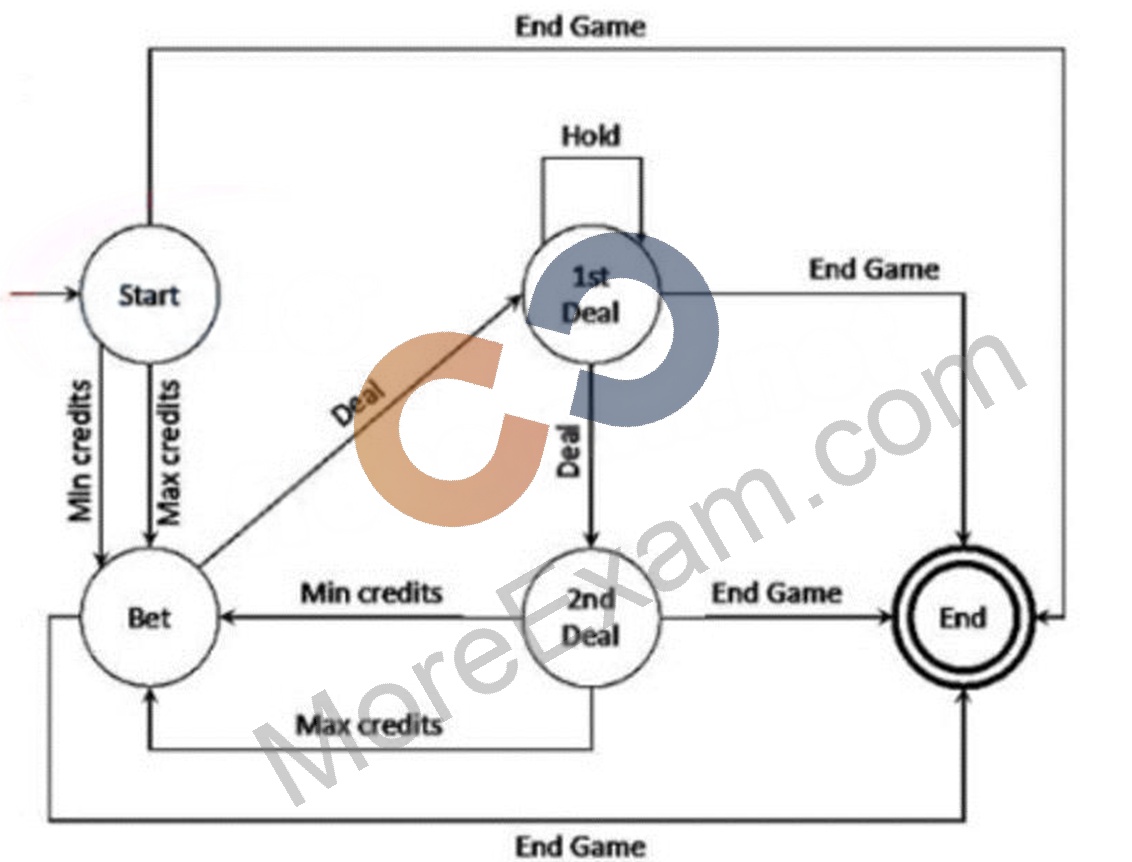
Question26: Consider the following simplified version of a state transition diagram that specifies the behavior of a video poker game:

What Is the minimum number of test cases needed to cover every unique sequence of up to 3 states/2 transitions starting In the "Start" state and ending In the "End" state?

Question27: Which of the following statements about the value of maintaining traceability between the test basis and test work products is not true?

Question28: The following rules determine the annual bonus to be paid to a salesman of a company based on the total annual amount of the sales made (referred to as TAS).
If the TAS is between 50k€ and 80k€, the bonus is 10%. If the TAS exceeds 80k€ by a value not greater than 40k€, the bonus is 15%. Finally, if the TAS exceeds the maximum threshold which entitles to a 15% bonus, the bonus is 22%.
Consider applying equivalence partitioning to the TAS (Note: 1k€ = 1000 euros).
Which one of the following answers contain only test cases that belong to the same equivalence partition?

Question29: What type of testing measures its effectiveness by tracking which lines of code were executed by the tests?

Question30: During component testing of a program if 100% decision coverage is achieved, which of the following coverage criteria is also guaranteed to be 100%?

Question31: Which of the following statements is true?

Question32: The fact that defects are usually not evenly distributed among the various modules that make up a software application, but rather their distribution tend to reflect the Pareto principle:

Question33: Consider the following user story about the authentication functionality of an e-commerce website:
"As a logged-in user, I want to change my current password with a new one, so that I can make my account safer".
The following are some of the acceptance criteria defined for the user story:
[a] After the logged-in user has successfully changed his password, an email confirming the change must be sent to him
[b] To successfully change the password, the logged-in user must enter the current password, enter a new valid password, and finally confirm by pressing the 'Change Password' button
[c] To be valid, the new password entered by the logged-in user is not only required to meet the criteria related to the length and type of characters, but must also be different form the last 5 passwords of that user
[d] A dedicated error message must be presented to the logged-in user when he enters a wrong current password
[e] A dedicated error message must be presented to the logged-in user when he enters the correct current password, but enters an invalid password Based only on the given information, which of the following ATDD tests is most likely to be written first?